
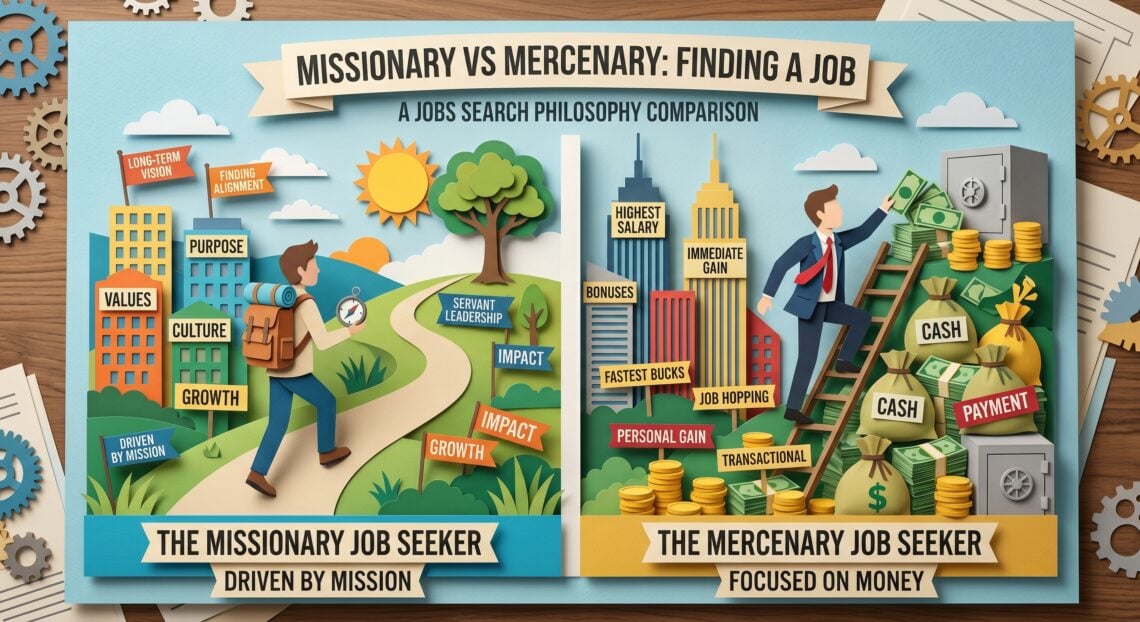
I’ve touched on the career lifecycle a few times now – from interviewing, to recruiting, to frameworks to maximize the job search. But now, I’m at a junction point to really unpack and explore the more major question: ‘Why?’ At some point in all people’s careers — usually not at the beginning, and hopefully not at the end — most of us pause and ask a question that feels uncomfortably revealing: Why am I really here?
(Don’t worry, we’re keeping it career-oriented, not existential .)
Not what do I do, or what am I good at, but why did I choose this job, this company, this season of work? For me, that question keeps getting reflected in the following opposites: The Mercenary versus the Missionary.
Much like Miracles vs Marvels, this isn’t about choosing a “right” side. It’s about understanding which force is actually pulling you forward — and what it costs to ignore it. What are the tradeoffs between these very different drives?
What Do I Mean by Mercenary and Missionary?
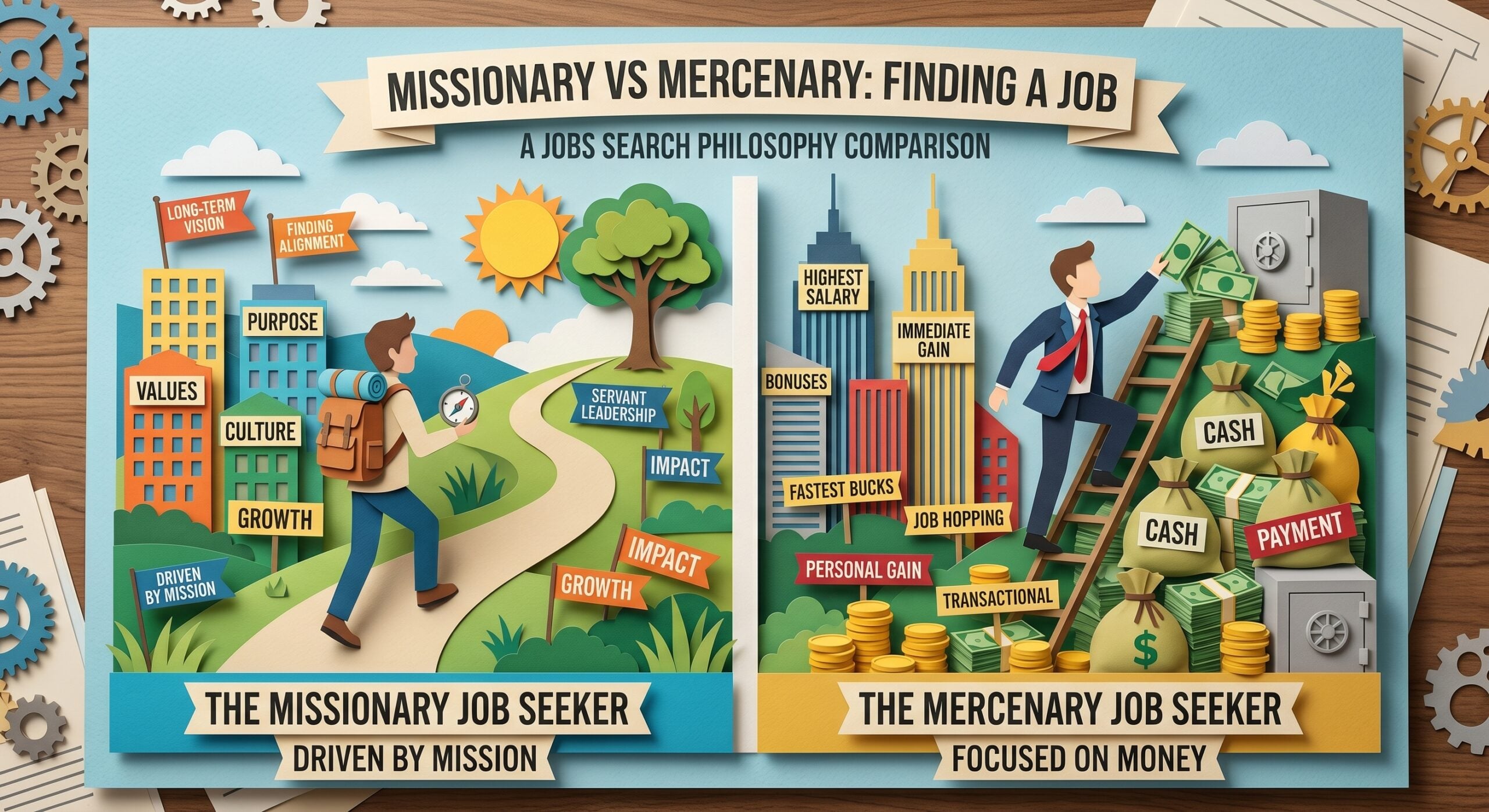
These labels, or ones like them, sometimes show up in startup culture, usually in hushed tones or coded language. I personally used it as a term of disparagement when employees joined with better life balance and different principals, deciding to go home to their families instead of burning the midnight oil on a problem that would be forgotten in a week. They just weren’t as bought in.
But stripped of moral weight, they’re surprisingly simple:
- Mercenary: You join for the outcomes — compensation, equity, title, resume acceleration, optionality.
- Missionary: You join for the mission — belief in the product, the people, the impact, the story.
I think this distinction shows up not in the interview, but ultimately in how we endure the hard days.
A Spectrum, Not a Personality Test
Over the past few years, I’ve started to see these approaches as modes — more often dictated by life constraints than actual values.
Like the argument Garry Tan makes in Learn vs Earn: early in your career, optimizing for learning can radically out-earn short-term compensation later. That piece reframed an entire generation’s thinking by saying its not about morality, its about career strategy. Mercenary vs Missionary works the same way.
You can be:
- Mercenary out of necessity
- Missionary out of privilege
- Or oscillating between the two as life changes
Understanding where you are matters more than pretending you’re something you’re not.
Phase One: Mercenary Beginnings
I graduated during the beginning of the 2008 recession. My early career choices were severely limited as less companies were hiring for Associate Product Managers, and even software engineering roles were shrinking a bit. My first job out of college was for a small government contractor that had a habit of finding easy-to-clear engineers out of the Midwest and helping them move to Washington, D.C. Looking back, it was a great first-gig and helped me learn a lot in a bigger city, but it was purely a mercenary play.
Early mercenary work helps teach discipline, incentivies, and performance, but it doesn’t really touch on the ‘Why’.
Phase Two: Missionary Work — and the Cost of Belief
The middle of my career was spent as a Missionary – attempting to Build a Better Internet. Cloudflare wasn’t just a job — it was a directly attached to my identity. I loved being dan@ a hyper-growth company with a seemingly impeccable mission.
I believed I was working somewhere special. I believed in the mission. I loved the Internet, and it was a crucial part of helping me become who I am today. I grew up in small town Ohio, and the early Internet was my outlet to the world. I believed in the people. Everyone was so low ego. Even though the problems came in fast, everyone was helpful and onboard to address them. It felt like a unique time, place and technology with fascinating people.
And when belief is real, effort stops feeling like effort. Missionary work has a unique danger:
when your identity fuses with the mission, boundaries erode. Burnout doesn’t arrive as exhaustion.
Its devotion without recovery or celebration.
Note – The curse of a Missionary mindset is one of burnout. And that is a story I’ve already shared in great detail. I’ve already worked through that collapse. (One of the best parts of writing the burnout story is hearing from other random greyclouds how much it resonated with them.
Phase Three: The Unfulfilled Mercenary
After burnout, many of us swing the pendulum hard the opposite direction.
I did.
The most recent phase of my career was definitely a mercenary bend. I was chasing the title and the comp more than the mission. It was a conscious choice, and one I learned that didn’t really reflect what I enjoyed most about work. The meetings felt empty, the KPIs felt listless. There was now a financial benefit, but without any kind of emotional spark. I was competence without conviction – and in tech, that can only take you so far.
This was mercenary work stripped of any aspiration. It paid. I functioned. And it didn’t nourish. Once you’ve tasted missionary work — once you’ve known what it feels like to believe — it’s hard to work any other way.
The Real Question Isn’t Mission vs Money
The real question is timing and truth.
Ask yourself:
- What am I optimizing for right now?
- Am I honest about the trade I’m making?
- Do I have an exit plan from this mode — or am I pretending it’s permanent?
Just like in The 10 P’s of Career Perfection, clarity doesn’t come from maximizing everything — it comes from knowing which variables you’re consciously prioritizing.
A Quiet Conclusion
There’s nothing noble about missionary work if it destroys you. There’s nothing shameful about mercenary work if it funds your freedom. The danger is in possibily confusing the two, or not being clear on your intentions for a job, occupation or career. .
The healthiest careers likely ebb and flow across both modes, learning and earning, mistakes and triumphs. Its that sequence that makes it all interesting.
Ideally, people would be a Mercenary to build runway.
Then find a culture that fits for them and Missionary up to build meaning.
Then, ideally, the rarest of birds: Work that pays well and feels true.
So, what is your ‘Why’ right now?